Richiedi un preventivo
Sistemi per controsoffitto metallico decorativo
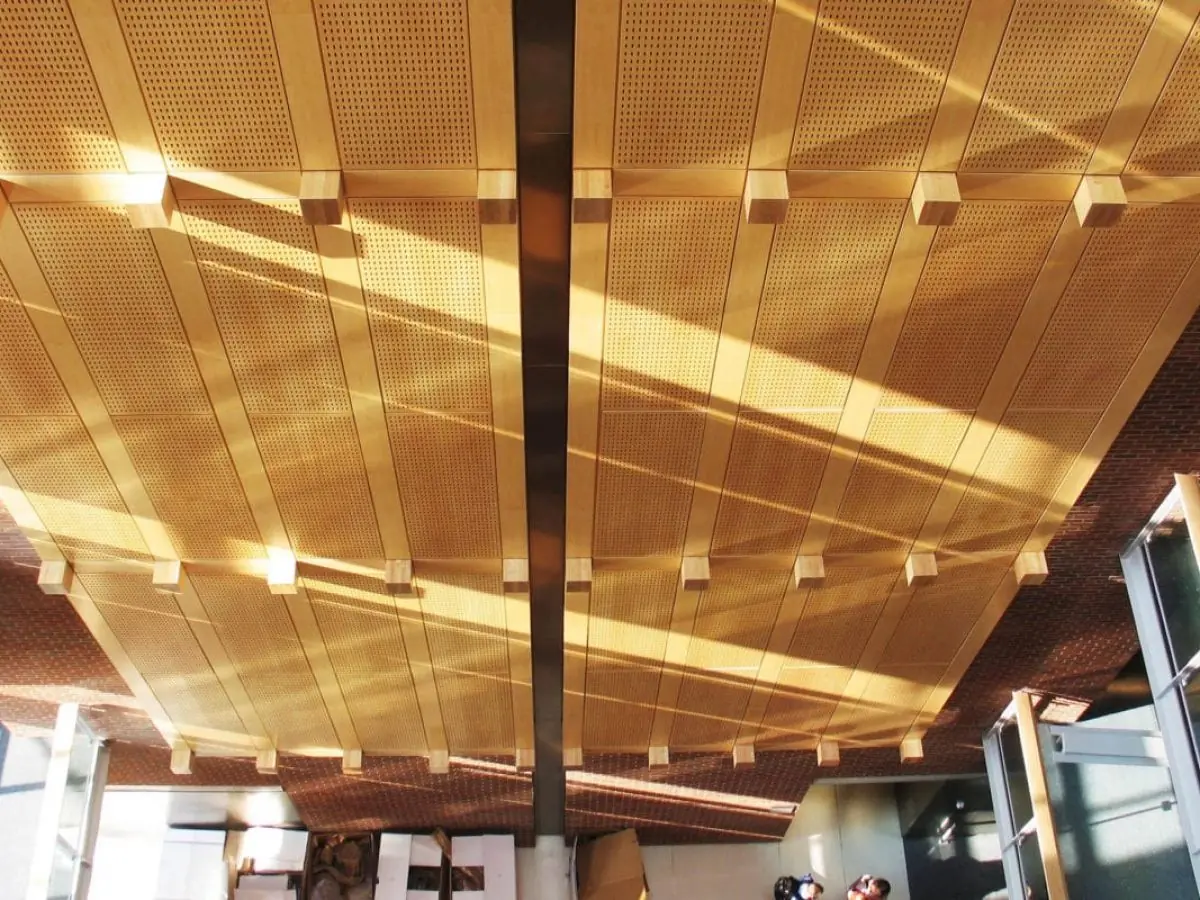
Controsoffitto metallico effetto legno
Controsoffitto metallico decorativo con stampa a sublimazione a venatura di legno - estetica del legno naturale unita alla durabilità del metallo e all'incombustibilità A2-s1,d0.
Material
AA3005/AA3105 aluminum / EN 10346 DX51D+Z galvanized steel
Module Sizes
Tiles 600x600, 600x1200 mm; linear and baffle formats + made to measure
Panel Thickness
Steel 0.5 - 0.8 mm / Aluminum 0.6 - 1.0 mm
Surface Finish
Sublimation wood-grain transfer over powder coating
Certificazioni
- EN 13964
- EN 13501-1: A2-s1,d0
- ISO 9001 quality management
- CE (EU Construction Products Regulation)
Risposta rapida
The wood look metal ceiling is a decorative suspended ceiling created by sublimation wood-grain transfer printing onto powder-coated metal panels. It combines real wood aesthetics with EN 13501-1 A2-s1,d0 non-combustibility, moisture resistance and NRC up to 0.85 acoustics, available in tile, linear and baffle formats.
The wood look metal ceiling is a decorative suspended ceiling solution in which natural wood grain is transferred onto powder-coated metal panels using sublimation wood-grain transfer printing. It carries the warmth of real wood while offering the durability, dimensional stability and easy maintenance of a non-combustible metal surface - completely eliminating risks of moisture, insects and cracking.
Panel bodies are produced from AA3005/AA3105 aluminum alloy or EN 10346 DX51D+Z galvanized steel, with thickness options of 0.5-0.8 mm (steel) and 0.6-1.0 mm (aluminum). Alongside standard patterns such as oak, walnut, teak, maple and wenge, project-specific designs are developed. Because sublimation printing penetrates the coated surface at high temperature, it shows high resistance to scratching and fading.
The system is available in tile panel, linear panel and baffle formats. With perforation (R22-R38) and acoustic infill, sound absorption in the NRC 0.55-0.85 band is achieved - concert halls, restaurants and hotels gain both wood aesthetics and acoustic comfort. Technical services remain hidden in the ceiling plenum while the natural grain adds warmth to the space.
It offers a clear advantage over timber finishes in fire safety: the panel body is classified A2-s1,d0 according to EN 13501-1. Unlike real wood ceilings, it belongs to the non-combustible class, making it the compliant way to achieve wood aesthetics in escape routes, assembly areas and spaces restricted by fire regulations for timber. The carrier system complies with EN 13964.
Installation is identical to standard metal ceiling systems: tiles lay or clip into the grid, while linear and baffle formats attach to carriers with clip-on connections. Panels are matched by production batch and direction marks for pattern continuity; radial and diagonal pattern transitions are planned from project drawings.
Applications include hotel lobbies and restaurants, malls and boutiques, office entrance areas, cultural and conference centers, metro and railway stations and residential common areas. Typical lead time is 2-4 weeks; series production starts after pattern sample approval, with regular shipments to 7 export markets.
| Material | AA3005/AA3105 aluminum / EN 10346 DX51D+Z galvanized steel |
|---|---|
| Module Sizes | Tiles 600x600, 600x1200 mm; linear and baffle formats + made to measure |
| Panel Thickness | Steel 0.5 - 0.8 mm / Aluminum 0.6 - 1.0 mm |
| Surface Finish | Sublimation wood-grain transfer over powder coating |
| Pattern Options | Oak, walnut, teak, maple, wenge + custom patterns |
| Perforation Options | Plain or R22 - R38 patterns (acoustic option) |
| Acoustic Performance | NRC 0.55 - 0.85 (perforation + acoustic infill) |
| Fire Classification | EN 13501-1: A2-s1,d0 |
| Installation System | Lay-in / clip-in grid or baffle carrier |
- Hotel lobbies and restaurants
- Mall corridors and boutique stores
- Office entrances and common areas
- Cultural and conference centers
- Metro and railway stations
- Residential and site common areas
- Realistic wood grain with sublimation transfer printing
- Non-combustible unlike timber: EN 13501-1 A2-s1,d0 class
- No moisture, insect or cracking risk; dimensional stability
- Available in tile, linear and baffle formats
- NRC 0.55 - 0.85 acoustic performance (perforated)
- Oak, walnut, teak, maple, wenge + custom pattern development
- Scratch and fade resistant surface with low maintenance
Installazione e applicazione
- 1 Ceiling level is set out and the grid or baffle carriers are aligned.
- 2 Tiles are laid into the grid, or linear and baffle elements are attached with clip-on connections.
- 3 Pattern continuity is secured by matching panels according to production batch and direction marks.
- 4 For perforated panels, acoustic infill is placed on top of the panel.
- 5 Lighting, diffuser and sprinkler openings are completed with matching accessories.
- 6 After level, pattern transition and joint checks, protective films are removed at handover.
Domande frequenti
La stampa a trasferimento della venatura del legno viene applicata per sublimazione sulla superficie metallica verniciata a polvere; poiché il disegno penetra nello strato di rivestimento, appare e si usura come legno vero senza sbiadire. Le venature di rovere, noce, teak, acero e wengé sono standard.
Il pannello è incombustibile A2-s1,d0 secondo EN 13501-1; a differenza del legname non si gonfia con l'umidità, non si crepa e non subisce danni da insetti, e basta una pulizia annuale con un panno umido. È la soluzione conforme alle normative antincendio per l'estetica del legno dove il legname massiccio è vietato.
In formato pannello a piastra (600x600, 600x1200 mm), pannello lineare e doghe, con produzione su misura. Il tempo tipico è di 2-4 settimane; la data esatta di consegna è indicata nel preventivo.
Il corpo del pannello è classificato A2-s1,d0 secondo EN 13501-1: incombustibile, senza propagazione di fiamma né gocciolamenti infiammabili. Il sistema di supporto è conforme a EN 13964.
I pannelli forati (R22-R38) combinati con materiale fonoassorbente soprastante raggiungono un assorbimento NRC 0,55-0,85, contribuendo al controllo del riverbero in sale da concerto, ristoranti e hotel.
Oltre alle venature standard del legno si sviluppano disegni specifici per progetto e il rivestimento di base può essere preparato in qualsiasi colore RAL; nei grandi progetti la produzione in serie inizia dopo l'approvazione del campione della venatura.